Clarity before code.

Through Product Discovery & Strategy

Most products fail not because they were built badly, but because they were built without first understanding who they were for, what problem they were solving, and whether that problem was worth solving. Kormoan’s product discovery services answer those questions before a single sprint begins. Build the right thing before you build it well.

0 %
of software features are never discovered or rarely used.

Standish Group

0 +
Years helping organisations discover before they build.

Kormoan

0 X
Higher cost to fix defects after release vs in discovery

IBM

0 %
of AI projects make it from prototype to production.

Kormoan - Design for AI

Kormoan Product Discovery Principle

"Discovery is not the phase before the real work. It is the work that makes everything else real."

Why this matters

The most expensive product mistake is building something users don't need.

Product discovery services exist to close that gap — to ensure the team is solving the right problem, for the right people, in a way that’s technically and commercially viable, before a single line of production code is written.

The Standish Group’s CHAOS Report consistently finds that over a third of software projects are cancelled outright, and only a fraction deliver what was originally intended. The root cause, almost universally, is insufficient discovery before development.

Read the full report here.

You cannot build your way out of the wrong problem

More sprints, more features, more velocity — none of it helps if the product is solving a problem users don't have, or solving it in a way they don't want. Discovery is the discipline that prevents this. It is not preparatory work; it is the most important work.

Assumptions made in a boardroom are not the same as user truth

Every product begins as a set of assumptions. The question is whether those assumptions are tested before you commit development resources, or after. Discovery moves that test to before — when it's cheap to be wrong — rather than after, when it isn't.

A poorly defined product brief produces a well-built wrong thing

Development teams are skilled at executing against a brief. They are not always positioned to challenge it. Product discovery services provide the structured environment in which the brief itself is interrogated, stress-tested, and sharpened before execution begins.

Stakeholder alignment before development prevents expensive pivots during it

Many product projects lose weeks to disagreements that could have been resolved before the first sprint. Discovery creates a shared understanding — of the user, the problem, the solution approach, and the success criteria — that holds under the pressure of development.

How we work

The Kormoan Product Discovery Framework™

A five-phase structure designed to move from ambiguity to decision — with confidence. Every phase produces tangible outputs that feed the next, and the whole is structured so that a go/no-go decision can be made at any point with full information.

01 — Strategy
Product Vision & Strategy

We work with leadership to articulate a product vision that is ambitious enough to be motivating and specific enough to be useful. This includes positioning analysis, competitive differentiation, business model alignment, and success metric definition — the strategic foundation that every subsequent product decision should trace back to.

02 — Research
User Research & Insight

Primary user research — interviews, contextual observation, diary studies, and moderated concept tests — conducted by researchers who have built the products they’re researching. Not surface-level empathy mapping. Deep enquiry into mental models, existing behaviours, latent needs, and decision triggers that inform a genuinely user-centred product direction.

03 — Definition
Product Definition & Scoping

The bridge between insight and execution. We define the product: what it does, what it doesn’t do, and why. Feature prioritisation using MoSCoW and value/effort matrices, user story mapping, epic-level scope definition, and a phased delivery plan that matches your resource reality and commercial timeline.

04 — Design
UX Concepts & Prototyping

Conceptual UX work that validates product direction before investing in high-fidelity design. Information architecture, key interaction flows, and low-to-mid fidelity prototypes built specifically for concept validation with users — not for developer handoff. The goal is to learn what works at the lowest possible fidelity.

05 — Technical
Technical Discovery & Architecture

Engineering input into the discovery process — not as an afterthought but as a constraint and enabler from day one. Technology stack evaluation, build vs. buy analysis, integration mapping, data architecture considerations, and a high-level technical direction document that development teams can begin detailed planning against.

06 — Output
Roadmap & Investment Brief

The discovery output structured for decision-making. A phased product roadmap with rationale, an investment brief formatted for board or investor presentation, resource and timeline estimates, and a risk register. Everything a leadership team needs to make a confident go/no-go decision and commission the right level of development resource.

Engagement Types

Four ways to engage Kormoan for product discovery.

The right engagement depends on the complexity of your product, the maturity of your thinking, and where you are in the build lifecycle. We’ll tell you honestly which one fits your situation — and whether you need one at all.

Engagement 01

Focused Discovery Sprint

2 weeks · Well-scoped problems

For organisations with a reasonably clear idea of what they want to build but who need validated direction on UX approach, feature scope, and technical architecture before commissioning development.

  • Stakeholder alignment workshop (half-day)
  • User research (5–8 interviews + synthesis)
  • Competitive & analogous landscape review
  • Core UX flows and lo-fi prototype
  • Prioritised feature set and initial roadmap
  • Technical architecture brief
Engagement 02

Full Discovery Programme

4–6 weeks · Complex or unclear problems

Kormoan’s flagship product discovery engagement. For new products, significant pivots, or platforms where the problem space is genuinely uncertain and needs thorough research and definition before investment is committed.

  • Full stakeholder alignment programme (multi-session)
  • Deep user research (10–15 interviews + observation)
  • Market sizing and competitive intelligence
  • User personas, validated journey maps, insight themes
  • Full UX concept exploration and user testing
  • Technical discovery and architecture options
  • Phased roadmap, investment brief, and risk register
Engagement 03

Enterprise Discovery

6–12 weeks · Enterprise complexity

For enterprise-scale digital product initiatives where multiple user segments, complex integrations, regulatory constraints, and organisational change management are part of the product challenge — not just the technical one.

  • Everything in the Full Discovery Programme
  • Multi-segment user research across personas
  • Regulatory & compliance landscape mapping
  • Systems integration and data architecture discovery
  • Change management and adoption strategy
  • Board-ready investment case and phased programme brief
Engagement 04

Strategic Advisory

Monthly retainer · Ongoing product direction

For product teams that need a senior strategic partner on retainer — someone who can challenge roadmap decisions, bring an external user perspective, and help prioritise across competing product demands without the overhead of full-time headcount.

  • Monthly strategy sessions with a named Kormoan lead
  • Ad-hoc research and design review support
  • Roadmap and prioritisation challenge sessions
  • Access to Kormoan Product Framework™ tools
  • Priority access to research, design, and engineering capability
Capabilities

The methods behind the rigour.

Kormoan’s product discovery practice draws on research methods, design frameworks, and engineering expertise that most studios apply separately. We apply them together — which is why our discovery outputs hold up under the pressure of real development.

Jobs-to-be-Done Research

JTBD-structured user interviews to understand the causal mechanisms of user behaviour — not just what people do, but what they're trying to accomplish, and why they'd hire or fire a product to do it.

User Story Mapping
User Story Mapping

Jeff Patton-style story mapping workshops that produce a shared visual understanding of the product — how users move through it, what they need at each step, and where the MVP line sits.

Assumption Mapping & Prioritisation

A structured method for surfacing and prioritising the riskiest assumptions in a product — so discovery effort is focused where it matters most, not spread evenly across everything.

Lean Hypothesis Testing

Build–measure–learn loops applied to the discovery phase. We design the minimum experiment necessary to test a product hypothesis and move fast through learning cycles before committing to design direction.

Desirability, Viability & Feasibility

The IDEO three-lens framework applied to every solution concept — ensuring the product direction is something users want, the business can sustain, and engineers can build within available constraints.

Competitive & Analogous Research

Deep analysis of direct competitors, adjacent markets, and analogous products — to understand the landscape, identify white space, and ensure the product isn't solving a problem the market has already answered.

Design Sprint Facilitation

Jake Knapp's Design Sprint methodology adapted for Kormoan's discovery context — five days of structured problem-solving, prototyping, and user testing that produces validated direction without weeks of debate.

Product Roadmapping & Prioritisation

Outcome-based roadmaps — not feature lists with dates. We build roadmaps around the outcomes the product needs to produce, with a clear sequencing rationale and explicit decision criteria for each phase boundary.

Technical Architecture Discovery

Engineering input into the discovery phase to establish technical direction, identify integration dependencies, assess build-vs-buy trade-offs, and produce a technical brief that development teams can begin detailed planning against.

Industries

We've discovered products in the sectors that demand it most.

Product discovery is most valuable where the cost of building the wrong thing is highest. These are the industries where Kormoan has conducted formal product discovery engagements.

Related case studies

Decisions made before development began.

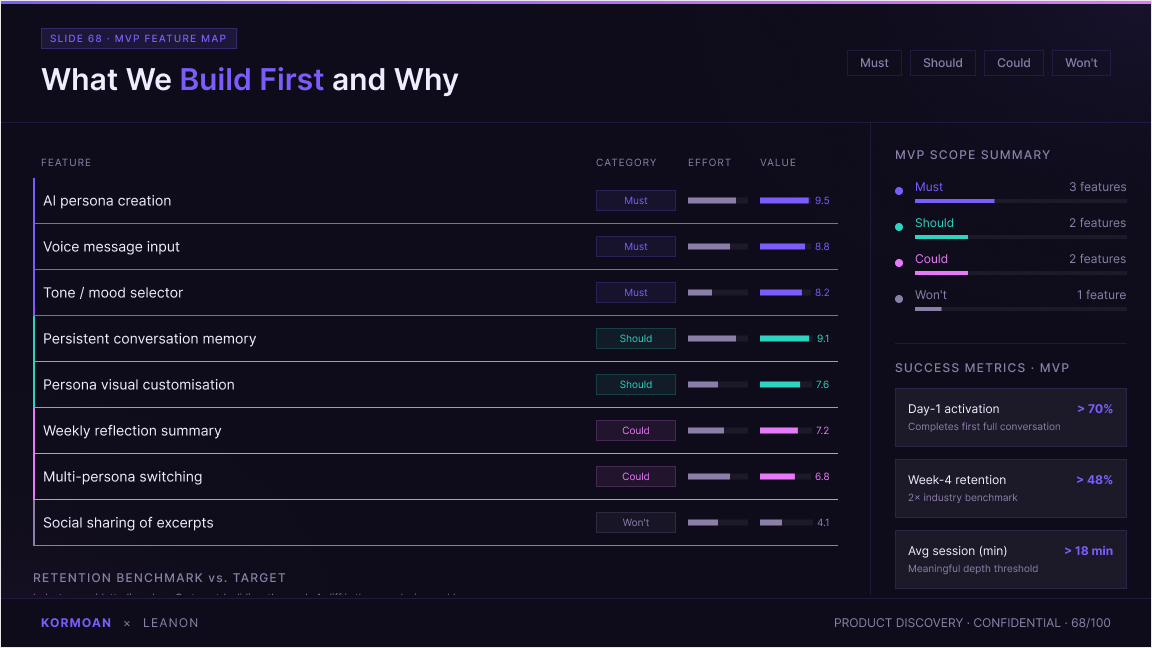
Human-Centered AI for meaningful conversations
Human-Centered AI for meaningful conversations

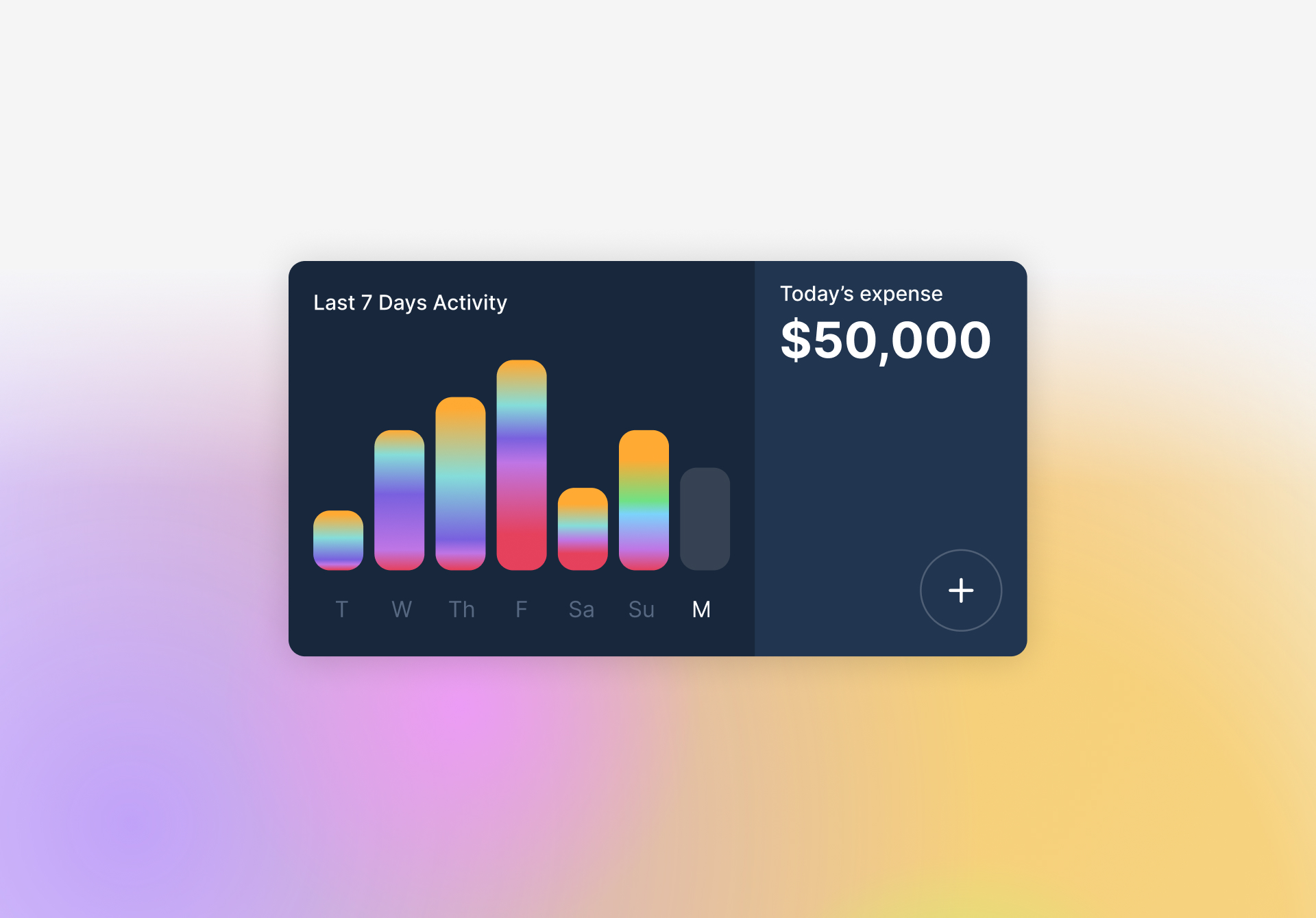
A different kind of finance app.
A different kind of finance app.

Where ancient wisdom meets AI-Powered experiences.
Where ancient wisdom meets AI-Powered experiences.
Related thinking

Perspectives on product discovery.

Why Kormoan

We are not researchers who hand off to designers. We are both — and we build too.

Most product discovery agencies deliver a report and disappear. Kormoan’s product discovery practice is integrated with our design and engineering capability — so the team that discovers the product can also design and build it, without a knowledge handoff that erases half of what was learned.

Integrated research, design, and engineering

Our product discovery team spans UX research, product strategy, interaction design, and technical architecture. Discovery outputs are reviewed by the people who will execute against them — before they leave the building.

The Kormoan Product Framework™ — not a generic methodology

Our discovery process is a proprietary framework developed across more than a decade of digital product work. It is adapted to your context, not applied as a template — because no two product problems are the same.

We challenge the brief, not just respond to it

We will tell you if we think you're solving the wrong problem. That is not comfortable, but it is the most valuable thing a discovery partner can do — and it is why organisations hire Kormoan rather than an agency that will execute whatever they're told.

Discovery outputs built for decision-making, not filing

Every deliverable is designed with its end use in mind — whether that's a board decision, an investor meeting, or a development team kickoff. We produce artefacts that actually get used, not documents that get archived.

Continuity from discovery through to launch

If you choose to engage Kormoan for design and development after discovery, the same team continues. No re-briefing, no institutional memory loss, no translation errors between discovery and delivery. The thread of understanding runs unbroken from problem to product.

What people ask before commissioning a product discovery engagement.

Straightforward answers to the questions we hear most often. If yours isn’t here, reach-out to us.

What exactly is a product discovery sprint?

A product discovery sprint is a structured 2–6 week engagement where a cross-functional team investigates user needs, validates key assumptions, and defines the scope and approach for a digital product before development begins. The output is not a prototype or a finished design — it is a decision framework: clarity on what to build, for whom, and why, at a level of confidence that justifies committing a development budget.

We already know what we want to build. Do we still need product discovery?

Especially then. The most expensive discovery failures are organisations that were certain about what they wanted to build, built it, and found it didn’t solve the actual problem — or didn’t solve it in a way users would adopt. Discovery is not about generating an idea. It is about stress-testing yours against user reality, technical constraints, and commercial viability before committing a development budget. Certainty, untested, is the most dangerous state to be in.

How long does Kormoan's product discovery process take?

It depends on the complexity of the product and the clarity of the problem. A Focused Discovery Sprint runs 2 weeks and suits well-scoped problems. Our Full Discovery Programme runs 4–6 weeks and is suited to new products or significant pivots where the problem space is genuinely uncertain. Enterprise Discovery engagements run 6–12 weeks where complexity, regulation, and organisational scale demand deeper research and definition. We’ll tell you which is right for your situation at the first call.

What are the deliverables from a Kormoan product discovery engagement?
Deliverables vary by engagement type but core outputs typically include: a product vision and strategy document, validated user personas and journey maps, a prioritised feature set with rationale (not a wish list), technical architecture brief, a phased product roadmap, and an investment brief structured for board or investor presentation. We design every deliverable for its actual end use — not as a filing exercise.
Can Kormoan run product discovery for an existing product, not just a new one?

Yes — and this is more common than people expect. We refer to this as a rediscovery engagement. It applies the same research and definition rigour to understand why an existing product isn’t performing: whether users are churning, engagement is flat, a major feature decision is looming, or the product needs to pivot in response to a market shift. The methodology is the same; the starting context is different.

Does Kormoan continue with design and development after discovery?

Yes, and this is one of our strongest differentiators. If you choose to engage Kormoan for design and development after discovery, the same team continues — no re-briefing, no institutional memory loss, no translation errors between discovery and delivery. The thread of understanding runs unbroken from problem definition to product launch. We also produce discovery outputs that are detailed enough for any development team to pick up, if you choose to work with a different partner for build.

Discovery call

Tell us what you're trying to build. We'll tell you how to find out if you should.

A 45-minute session with a Kormoan product strategist. No pitch. No deck. Just a direct conversation about what you’re trying to build, what you already know, and what you need to find out before development begins.

What we cover in the first call

We’ll come prepared with questions. You’ll leave with more clarity than you arrived with.

  • You walk us through what you want to build, what you already know, and what’s driving the timeline.
  • We share what we’d want to understand before committing to a direction, and what worries us about the brief as stated.
  • We recommend the right engagement type — Sprint, Programme, Enterprise, or Advisory — and explain exactly why.
  • If it’s a fit, we move to a scoping session the following week. If not, we’ll tell you — and point you towards whoever can help.

Let’s start the conversation.

Within 12 business hours, our team will reach out to schedule your discovery call.

Full Name *
Work Email *
Contact Number *
Budget
Description *
captcha image
Change

Ask about us, your product, challenge, or idea...

Human-Centered AI for meaningful conversations

  • Client

    Lean-on

  • Categories

    Design for AI, Product, Experience

  • Deliveries

    Research, UI, UX, Concept

View Project

A different kind of finance app.

  • Client

    sistem.app

  • Categories

    Website Design, AI

  • Deliveries

    Research, UI, UX, Concept, Development

View Project

Where ancient wisdom meets AI-Powered experiences.

  • Client

    Saarthi

  • Categories

    AI, App Design, Hybrid App

  • Deliveries

    Research, UI, UX, Concept

View Project

Designing for Bharat, at scale.

  • Client

    reverieinc.com

  • Categories

    Website Design, AI

  • Deliveries

    Development, Research, UI, UX, Concept

View Project