Where SaaS is going: the honest trajectory.

The trajectory of enterprise SaaS in 2026 is being written by three shifts simultaneously and most product teams are still building for a world that no longer exists. For fifteen years, the B2B software playbook was insultingly simple. You identified a manual business process, built a multi-tenant database around it, wrapped it in a clean web dashboard, and charged $45 per user per month. If you wanted to grow, you didn’t need to make the software smarter. You just needed more humans sitting in chairs clicking through your screens.

That playbook is officially dead.

In the middle of 2026, software isn’t failing because it lacks features. It is failing because the foundational assumptions of traditional SaaS… the seat-based business model, the human-centric graphical user interface, and generic horizontal utility are dissolving simultaneously.

When I published E-commerce shifts, again., we tracked how digital storefronts were morphing from static destinations into distributed, ambient touchpoints. The exact same structural transformation has arrived for enterprise software.

The future of SaaS isn’t about making prettier dashboards for humans. It is about building the invisible, governed substrate that autonomous AI agents rely on to run enterprise workflows.

If you are building, investing in, or buying enterprise software today, there are three massive structural shifts you must navigate.

Shift 1: From interface to substrate (The unforgiving move down the stack)

For two decades, software companies competed on UI/UX differentiation.

We celebrated clean navigation bars, drag-and-drop kanban boards, and customizable analytics widgets. We treated the dashboard as the core asset because humans needed visual clarity to perform Create, Read, Update, and Delete (CRUD) operations.

Here is the cold, uncomfortable reality of 2026: AI agents do not care about your UI.

An autonomous agent does not inspect your CSS buttons, appreciate your micro-animations, or admire your carefully styled data tables. An agent interacts with software purely through schemas, API endpoints, webhooks, and execution permissions.
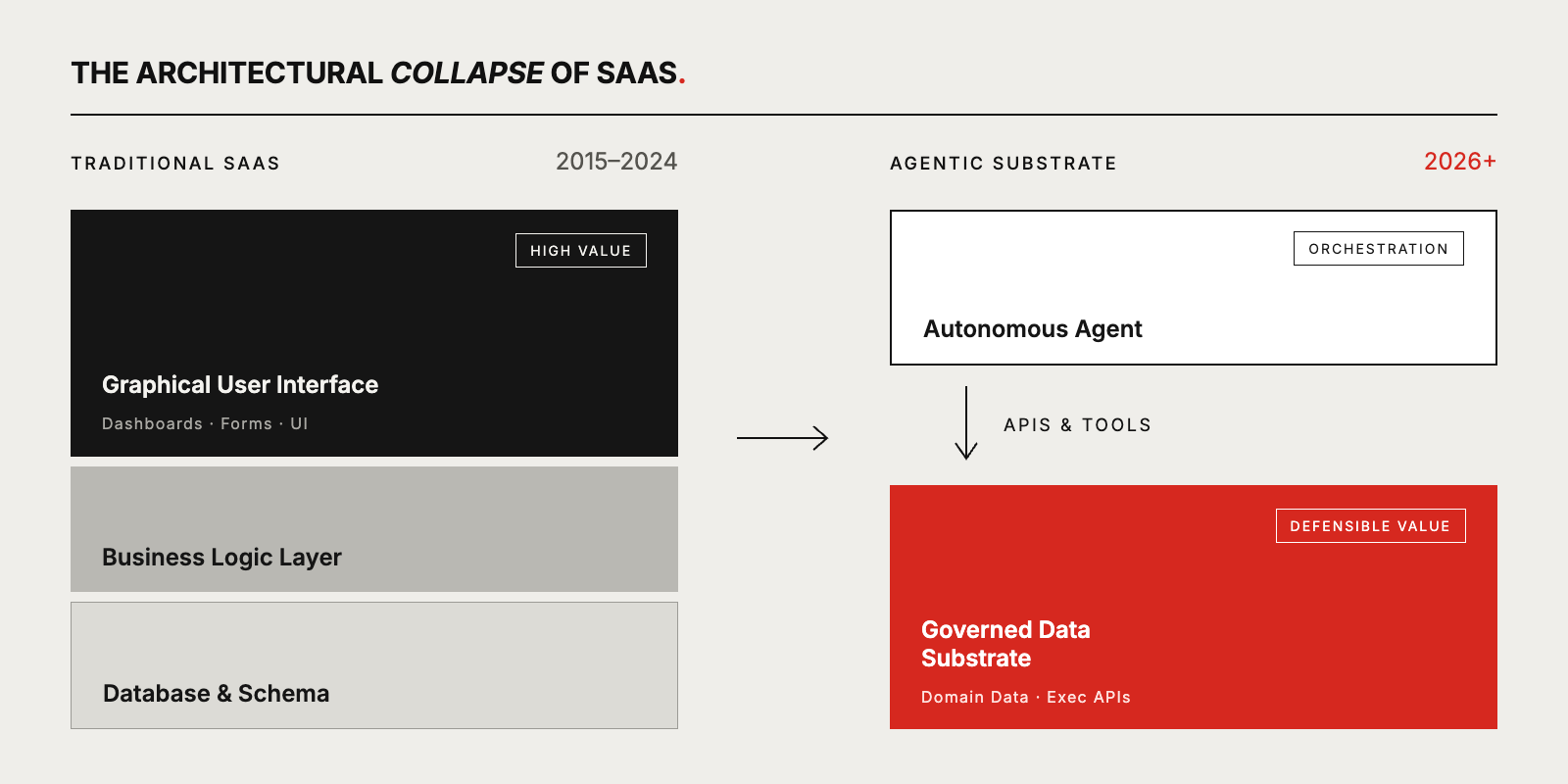
Winning software will increasingly be the trusted data-and-action layer that agents run on top of, not the pretty dashboard humans click through.

Value is moving aggressively down the stack, away from visual layout and toward whoever owns two things:

  1. The authoritative domain data schema.
  2. The governed action pathways.

The problem was never visual; it was complexity

When software functions purely as a dashboard, it forces human employees to act as human routers. A human reads an email, logs into a CRM, copies an ID, updates a status dropdown, and triggers a notification.

When you deploy AI agents into that workflow, the dashboard becomes an unnecessary bottleneck. The agent bypasses the visual UI entirely, reading directly from the database and triggering programmatic actions.

If your product’s primary value proposition is a friendly frontend sitting on top of generic database calls, an LLM can recreate your interface on the fly. In our practice focused on Design for AI, we constantly advise technical leaders that if an agent can execute the task without looking at your UI, your UI is not your moat.

Your moat is the governed substrate underneath. The transactional safety guarantees, audit logs, fine-grained access permissions, and domain telemetry that prevent an autonomous agent from destroying business state.

Shift 2: From seats to outcomes (The death of the $45/user monthly tax)

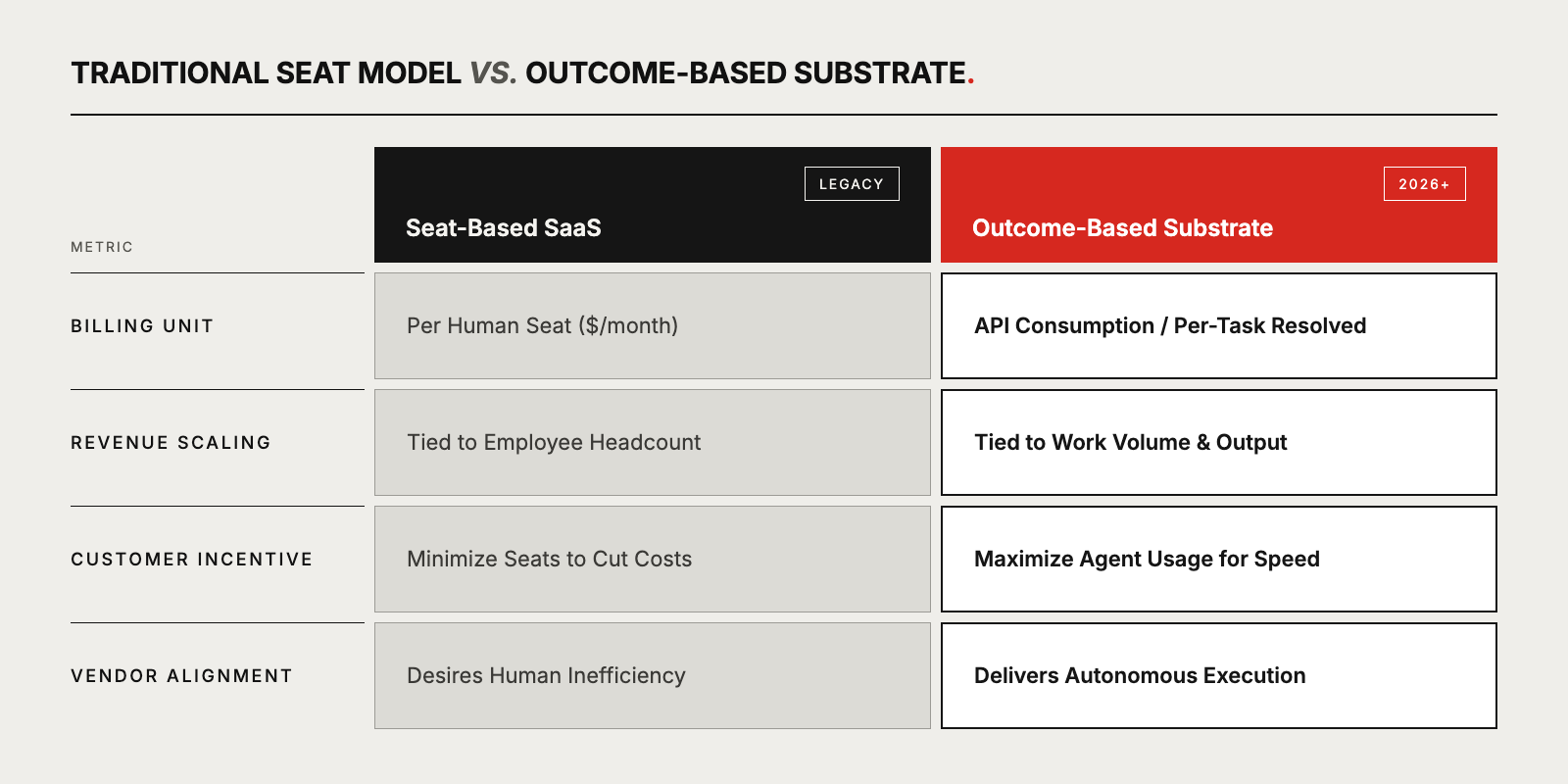
The classic SaaS business model was built on human inefficiency.

If a company hired 50 new operations reps, the SaaS vendor celebrated because it automatically meant 50 new software licenses. Software revenue scaled proportionally with headcount.


When agents do the actual work, per-user pricing stops making sense because there are fewer human users.

If an AI agent can perform the data entry, reconciliation, and customer triage previously handled by twenty human operators, enterprise buyers will inevitably consolidate down to two admin supervisor seats.

If a SaaS vendor remains anchored to per-seat billing, their average contract value (ACV) will collapse by 90% precisely when their software is delivering its highest operational output.

This isn’t theoretical speculation. The enterprise pricing collapse is already unfolding in real time.

The OpenAI OneGov benchmark

Look at OpenAI’s landmark OneGov 2.0 agreement with the U.S. government. Under this agreement, OpenAI explicitly set monthly seat license fees to $0 per user (slashing the previous $15/user rate), shifting the entire commercial model to pure, consumption-based usage with a 50% discount on API volume.

When the largest foundation model provider in human history prices government-wide enterprise access at $0 per seat, the market message is unambiguous: The seat tax is dead.

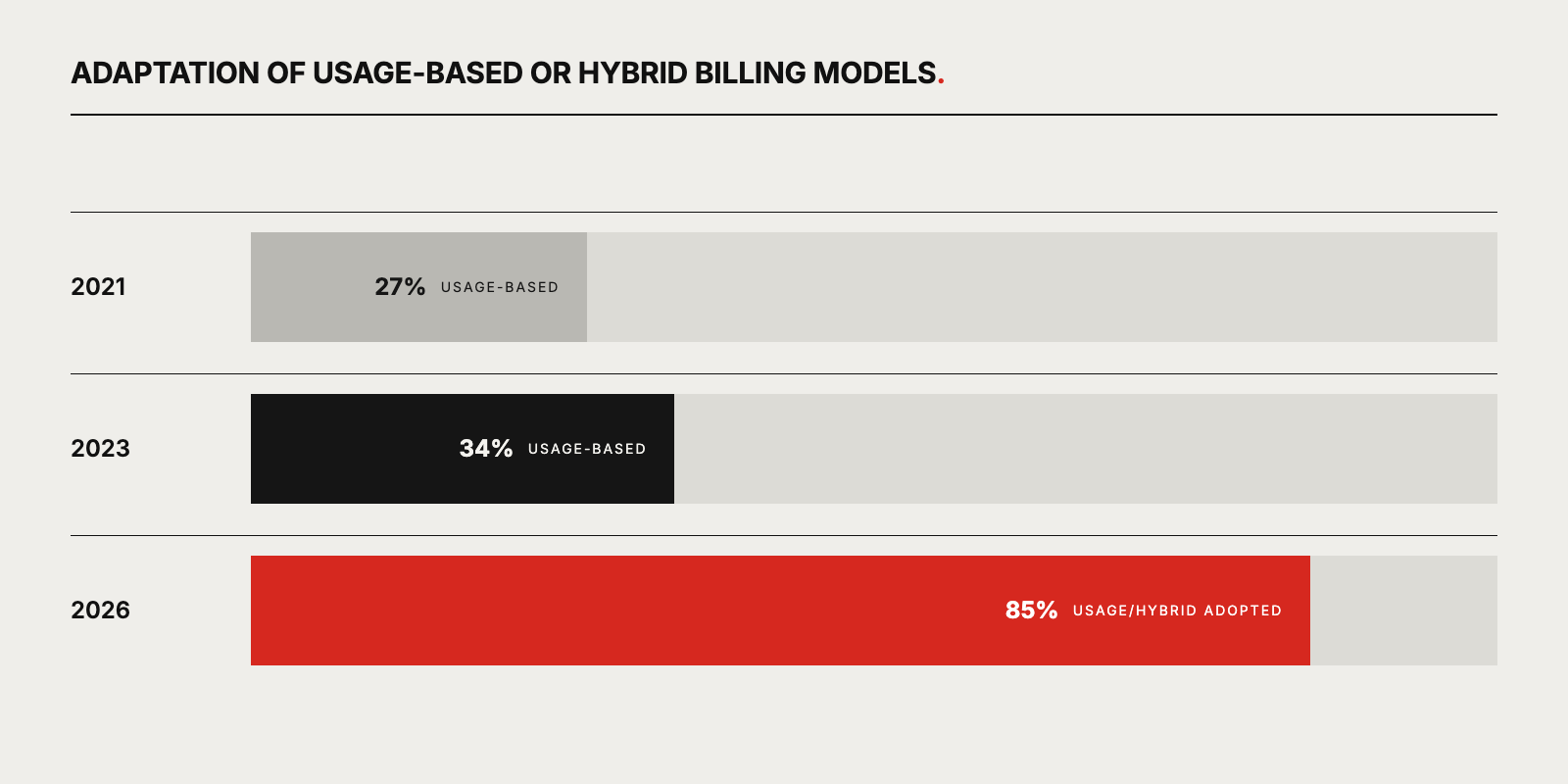
According to recent industry data from Metronome and Radixweb, over 85% of SaaS companies have now adopted usage-based or hybrid billing models, while primary seat-based subscriptions have dropped sharply to 57%.

Software vendors must align their monetization directly with consumption and business outcomes:

  • Not “How many managers log into this desk?” * But “How many claims were autonomously processed without human intervention?”
  • Not “How many sales reps have logins?” * But “How many qualified pipeline opportunities were programmatically closed?”

Shift 3: Vertical beats horizontal (Why the generic giant is replacement-ready)

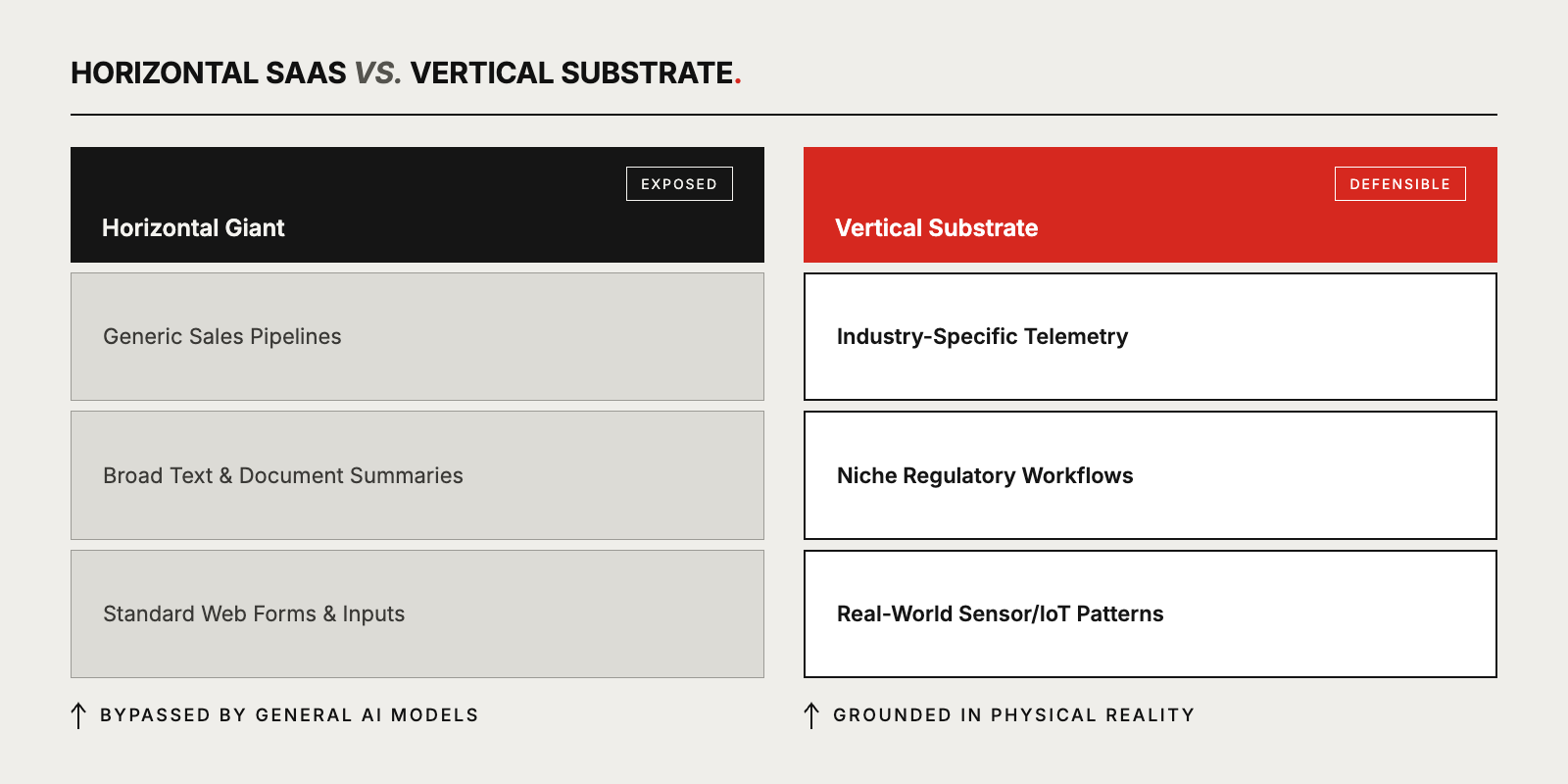
Horizontal SaaS giants like Salesforce, HubSpot, and Zendesk dominated the last era by prioritizing broad, industry-agnostic reach. They built generic visual tools that could be adapted to a hospital, a law firm, a construction site, or a software startup.

In 2026, horizontal giants are deeply exposed precisely because their generic interfaces are the most easily replaced.

A general-purpose foundation model (like GPT-5 or Claude 3.5) can already reason brilliantly about general sales pipelines, generic ticket routing, and standard email drafting. It does not need a $500/seat horizontal CRM to structure standard text or generate a pipeline forecast.

The software that survives is the software that owns domain-specific data and physical workflows an agent cannot access anywhere else.

The power of niche telemetry

A general AI model can write a compelling sales email.

It cannot reason about your commercial parking facility’s Tuesday RFID scanning patterns unless a specialized system captured, structured, and contextualized those physical signals first.

It cannot predict localized inventory spoilage across regional cold-chain facilities unless a vertical system digitized the raw sensor telemetry from the warehouse floor.

This is why vertical SaaS platforms are outperforming horizontal giants. Benchmark studies from Tidemark show that vertical software providers operate with 40% to 50% higher sales efficiency and dramatically lower customer acquisition costs than horizontal generalists.

When software is deeply embedded into the physical or domain-specific reality of a single industry like healthcare logistics, precision manufacturing automation, or specialized food supply chains it becomes impossible for a general LLM to dislodge.

The vertical software provides the ground truth context that AI agents require to act accurately. Without that grounded context, the agent is useless.

What we learned rebuilding commerce engine architectures

At Kormoan, our work across digital product strategy has required us to confront these architectural shifts head-on.

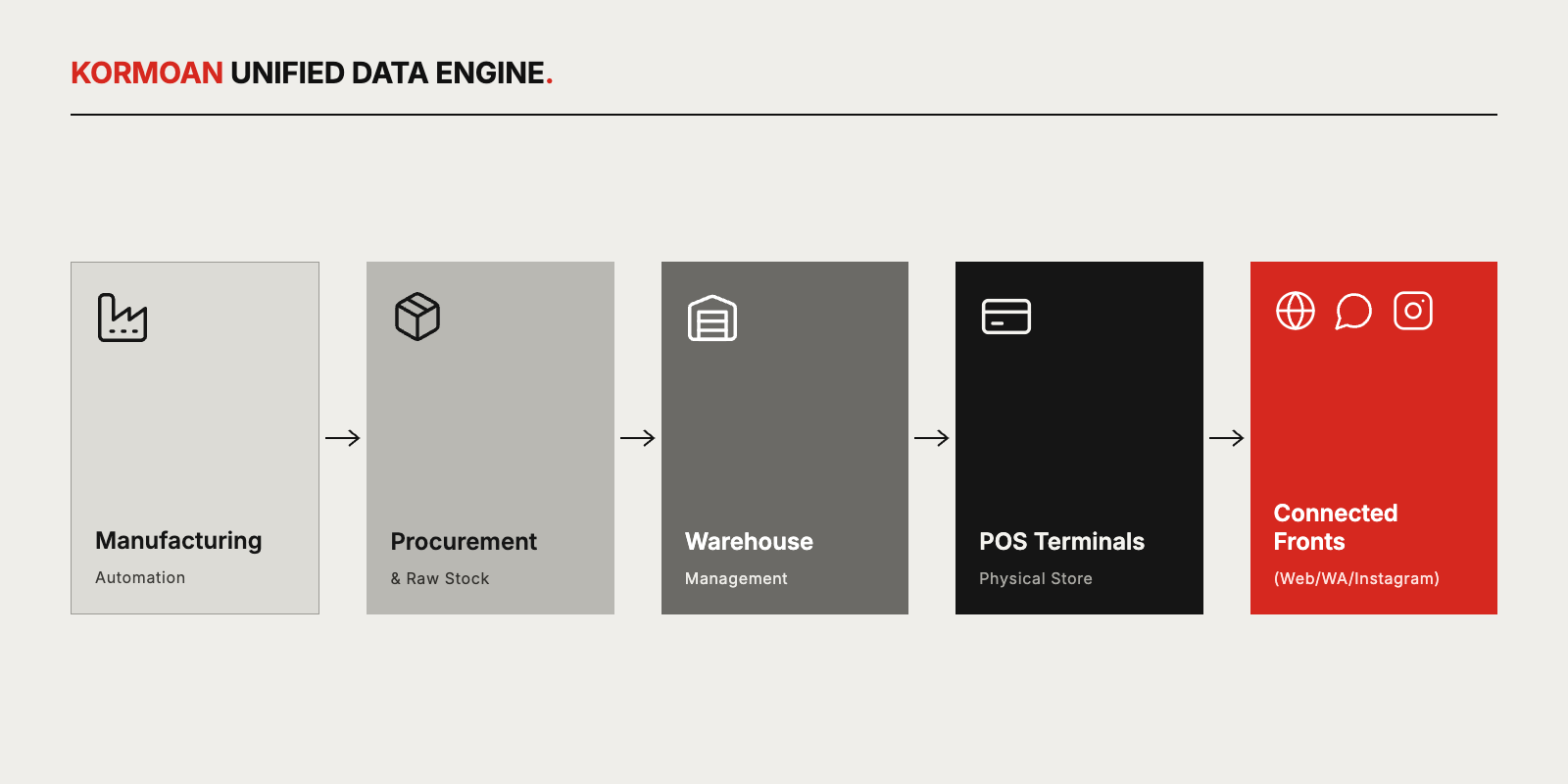
When we were brought in to conduct an intensive product discovery and system architecture redesign for Neelkanth Sweets, we didn’t just build an e-commerce website or a standalone POS terminal.

We built a unified digital engine connecting manufacturing automation, raw material procurement, kitchen batch schedules, physical POS counters, and conversational WhatsApp/Instagram social catalogs into a single, real-time data layer.

Because the underlying data schema was unified and exposed via high-integrity APIs, ambient AI agents could immediately orchestrate real-time tasks:

  • Re-routing perishable stock from kitchen batches based on immediate neighborhood demand signals.
  • Processing complex natural-language gift orders directly inside WhatsApp.
  • Syncing physical POS counter purchases with customer profiles in milliseconds.

The visual web interface wasn’t the core product. The unified, real-time operational substrate was the core product.

Whether we are designing for early-stage innovators or executing enterprise transformations, our experience across our work and case studies confirms a single truth: If your data layer isn’t clean, your AI strategy is an illusion.

How to audit your software portfolio for the substrate era

If you are a product leader, CTO, or founder evaluating your product roadmap or SaaS stack in 2026, run your system through this four-part diagnostic framework:

  1. The agent accessibility test: Can an external AI agent programmatically read your system’s state and execute core actions via secure APIs without opening your web UI?
  2. The seat reliance audit: If your largest customer cuts their human workforce in half by deploying autonomous agents, does your revenue drop by 50%, or does it grow based on consumption?
  3. The ground truth metric: Does your software capture unique, vertical-specific physical or operational data (e.g., IoT signals, compliance logs, supply chain batching) that a general LLM cannot extrapolate from public training data?
  4. The governance layer: Does your platform provide execution safety, transactional rollbacks, and granular permission controls that allow enterprise leaders to trust autonomous agents with write access?

The honest trajectory

Software is not disappearing. But the era of bloated, low-effort horizontal SaaS products taxing enterprises on per-seat human labor is coming to an end.

The winners of the next decade will build quiet, powerful, vertical-specific software substrates. They will welcome AI agents as primary users. They will charge fairly for verified business outcomes rather than idle user seats.

And they will understand that the most valuable software is no longer the dashboard that demands your attention, it is the invisible engine that quietly gets the job done.

If you are rethinking your enterprise software strategy, re-architecting legacy product engines, or designing platforms built for the agentic era, explore our digital product strategy services or reach out to the Kormoan strategy team directly.

Ashutosh Srivastava is the Founder and CEO of Kormoan, a design-led digital product studio with offices in New Delhi and Hopkins, Minnesota. Over 15 years he has helped founders, enterprise product leaders, and CTOs navigate the decisions that determine whether software products endure or get replaced. He writes about product strategy, AI, and the structural shifts reshaping enterprise software.

If you are rethinking your SaaS architecture, re-platforming a legacy product, or building for the agentic era…

Ask about us, your product, challenge, or idea...