

In the middle of 2020, at the height of the global COVID-19 lockdowns, I wrote an article titled E-commerce shifts, again.
At that point, the digital commerce landscape was experiencing a massive, forced migration. Businesses that had spent years debating whether an online store was necessary were suddenly forced to go digital overnight. Supply chains froze, brick-and-mortar storefronts went dark, and over 80% of consumers globally shifted their daily shopping online within a matter of weeks.
That period triggered a structural paradigm shift. It wasn’t just traditional retail giants pivoting to survive; it created an entire ecosystem of independent digital-first brands. Globally, multi-billion-dollar D2C powerhouses like Gymshark, Anker, and Warby Parker proved that you didn’t need legacy retail distributors to build global commerce empires.
In India, that wave gave rise to independent digital brands that fundamentally transformed consumer expectations around quality, fulfillment, and brand narrative.
What most leaders failed to see in 2020 was that the surge in online store creation was only step one.
Over the past six years, e-commerce didn’t simply settle into a mature state. It fractured, evolved, and reshaped itself through distinct operational waves.
Today, in 2026, we are standing in the middle of another shift.
E-commerce is no longer about building an independent website or launching a standalone mobile app. The era of isolated destination shopping is over. We have entered the era of Connected Commerce.
How We Got Here: From Quick Commerce to Social Reality
To understand where retail is going, we have to look closely at how consumer behavior broke away from traditional web storefronts over the last five years.
The Hyper-Local Revolution: Quick Commerce
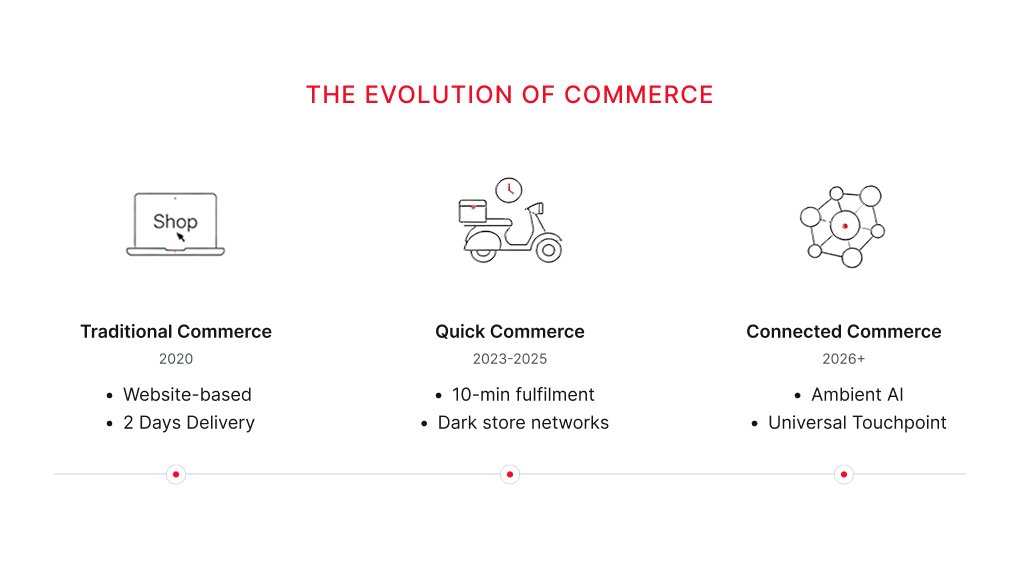
While traditional e-commerce established 2-day or 1-day shipping as the baseline, India pioneered a radical fulfillment model that caught the rest of the world off guard: Quick Commerce (Q-Commerce).
Platforms like Swiggy Instamart, Zepto, and Blinkit didn’t just speed up delivery they altered how households shop for daily essentials. The traditional monthly grocery trip or weekly pantry restock was dismantled and replaced by impulse-driven, 10-minute micro-orders.
According to data from MarkNtel Advisors, India’s quick commerce market expanded to $5.8 Billion in 2026, on track to hit $87.5 Billion by 2032 at a 56.9% CAGR.
Q-commerce proved a fundamental truth about modern human behavior: When you eliminate friction between need and fulfillment, consumer habits change permanently.
Social Commerce: From Hype to Operational Mainstream
A decade ago, industry analysts predicted that social media platforms would quickly replace traditional e-commerce storefronts. For years, however, social commerce struggled to live up to the hype. Users were happy to discover products on Instagram or Pinterest, but the moment they tried to buy, clumsy web redirects and fragmented checkouts killed conversion rates.
I have always remained deeply bullish on social commerce because of one fundamental human truth: Purchasing decisions have always been driven by recommendations, influences, direct conversations, and real-world inspiration. Digital commerce was always destined to replicate the friction-free, high-trust interactions of the real world.
That inflection point has finally arrived. Grand View Research reports that the global social commerce market has reached $1.92 Trillion in 2026, with Asia-Pacific accounting for 72.3% of global trade volume.
Social networks are no longer marketing channels that point toward a website. They are full-fledged, conversational transaction environments. Almost!
What Is Connected Commerce?
If 2020 was about creating an online destination (brand.com) and 2024 was about hyper-fast delivery networks, 2026 is about ubiquity.
Connected Commerce means meeting your customers where they already are, and giving them a continuous experience no matter where they go next.
Modern consumers do not think in channels. They do not say, “I am now interacting with this brand’s WhatsApp support channel” or “I am now browsing their physical retail store.” To the customer, your brand is a single entity. They expect you to:
- Recognize them instantly regardless of whether they tap an Instagram ad, walk up to a physical counter, or send a WhatsApp message.
- Sync their intent and cart state in real-time across direct messages, web browsers, and physical point-of-sale (POS) systems.
- Offer instant, human-grade support and re-ordering capabilities inside the communication apps they open fifty times a day.
Until recently, executing this level of ambient commerce was technically impossible or cost-prohibitive for most enterprises. You ended up with siloed databases: your Shopify store didn’t talk to your store POS, your WhatsApp business account didn’t know the customer’s previous order history, and your warehouse inventory updated on a 24-hour delay.
With the maturity of generative AI, open API architectures, and unified data layers, those technical walls have dissolved.
Connected Commerce isn’t a marketing strategy. It is an end-to-end operational architecture.
How Kormoan Architected Connected Commerce in the Real World
At Kormoan, we don’t treat digital strategy as a visual layer. We design digital platforms from the underlying operational logic out to the end-user interface. Over the years, our work across global markets has forced us to pioneer connected commerce frameworks across very different scales and product categories.
When we partnered with Qwikly, a dedicated social commerce platform, we focused on removing the friction between creator-led discovery and instant in-app checkout.
When working on Future, an immersive technology hardware brand, we explored how commerce interfaces adapt when screen boundaries disappear entirely.
And in independent retail, working alongside market leaders like Kent. One of India’s largest independent e-commerce brands, we designed scalable systems capable of handling massive transactional velocity without sacrificing customer clarity.
However, our most comprehensive execution of end-to-end Connected Commerce came through our work with Neelkanth Sweets.
Case Study: Rebuilding Neelkanth Sweets from Factory Floor to WhatsApp Catalog
Neelkanth Sweets is an iconic brand deeply rooted in tradition, operating high-volume physical counters, large-scale manufacturing facilities, and a rapidly expanding direct-to-consumer footprint.
When Neelkanth approached Kormoan, their challenge wasn’t simply “we need a new e-commerce website.” Their challenge was that their rapid physical and digital growth was stressing their legacy operational systems. High-perishable, high-demand products require hyper-precise inventory tracking, fast physical counter throughput, and flawless online order management.
We stepped back to execute a complete ground-up product discovery phase, evaluating every single link in their value chain.
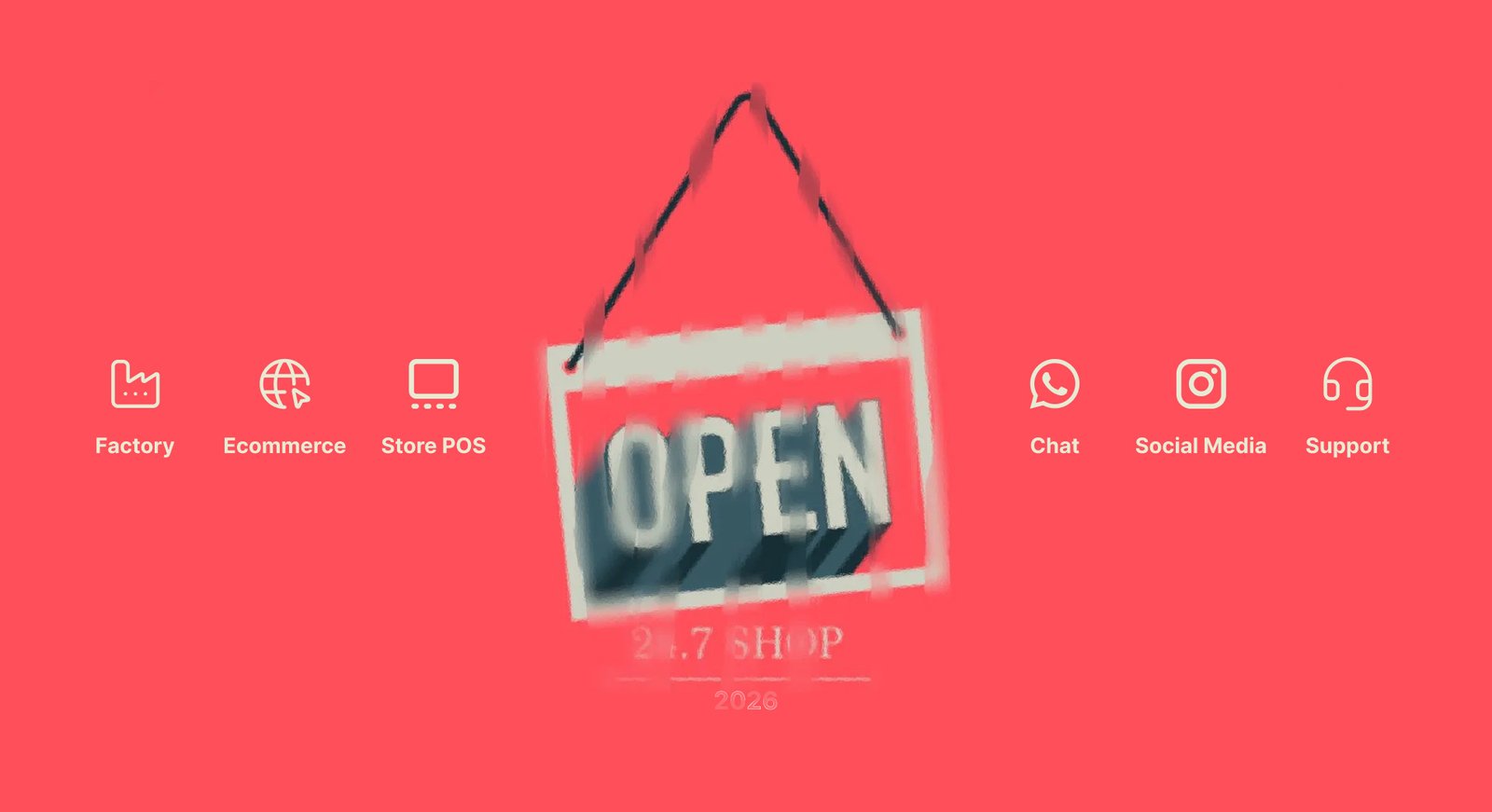
We built a unified digital commerce backbone that spans:
- Manufacturing Automation & Procurement: Digitizing daily production schedules, raw material batch tracking, and kitchen output based on predictive demand models.
- Stock & Warehouse Management: Real-time inventory tracking for highly perishable items, ensuring that stock allocated to physical retail counters never conflicts with online orders.
- Integrated Physical POS: Deploying modern point-of-sale systems across brick-and-mortar outlets that sync directly with the central inventory layer.
- Unified E-Commerce Storefront: A responsive web experience optimized for local deliveries, corporate gifting, and festive surges.
- Connected Social & Conversational Commerce: Native catalog integration directly within WhatsApp and Instagram, backed by AI support workflows.
What this looks like for the customer:
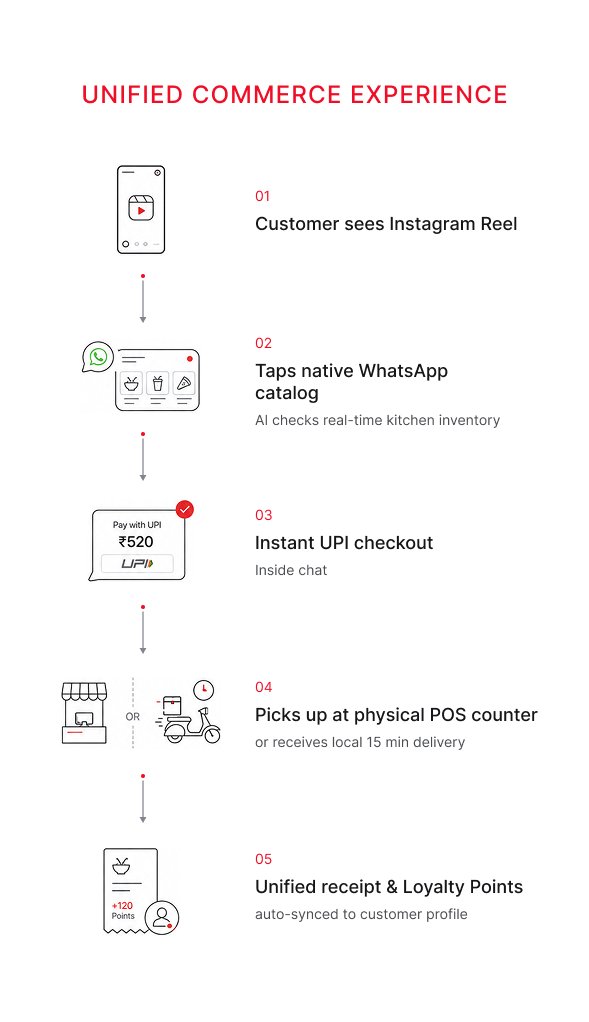
A customer can discover a seasonal sweet box on an Instagram Story, tap directly into a WhatsApp catalog conversation, customize their order with AI assistance, pay via UPI in seconds, and choose whether to pick up the order at a nearby counter or have it delivered to their doorstep via quick-commerce logistics.
If they walk into a physical Neelkanth outlet the next day, the POS counter staff can view their preference history, apply store loyalty benefits, and issue a digital receipt directly to their WhatsApp chat.
That is not multi-channel retail. That is Connected Commerce.
By connecting kitchen automation directly to conversational frontends, we helped Neelkanth eliminate stockouts, reduce order cancellation rates, and significantly lower customer acquisition costs.
The AI Layer: Moving from Reactive Interfaces to Ambient Commerce
You cannot build a scalable connected commerce ecosystem using human teams alone to manage every chat, inventory update, and support ticket. This is where strategic deployment of AI becomes mandatory.
In our practice focused on Design for AI, we emphasize that AI should not feel like an invasive chatbot that frustrates users with decision trees. Instead, AI must serve as an invisible coordinator between the customer’s intent and your enterprise systems.
TRADITIONAL COMMERCE AI vs. AMBIENT CONNECTED AI
Traditional Chatbot
User: “Where is my order #8492?”
Bot: “Please click this link, log into your account, and navigate to tracking.”
Connected Ambient AI
User: “Hey, is my sweet box ready for pickup at the Gomti Nagar outlet?”
AI: “Yes, Ashutosh! Batch #8492 was packed 10 mins ago. Show this QR code at Counter 2.”
How to Assess Your Connected Commerce Readiness
If you are a founder, CTO, or Head of Product evaluating your digital infrastructure in 2026, ask yourself these five questions:
- Is your inventory single-threaded? If a product sells out at a physical counter, does your website and WhatsApp catalog know within milliseconds, or do you risk overselling?
- Can your customers check out where they discover? Are you forcing users to leave Instagram or messaging apps to complete a purchase on a browser, or can they complete the transaction inside the flow?
- Does your support system know the user’s cross-channel history? When a customer messages your brand on WhatsApp, does your team see their physical POS purchases and previous online ticket history instantly?
- Is your back-office automated? Does an order placed on a social channel flow directly into your ERP, procurement, and kitchen/warehouse routing systems without manual human entry?
- Are you designing for decision fatigue? Is your interface trying to show hundreds of isolated products, or is it helping the user achieve their underlying intention with minimal cognitive friction?
Building What’s Next with Kormoan
E-commerce didn’t stop evolving when companies launched mobile apps, and it certainly hasn’t stopped with quick commerce.
The future of digital trade belongs to organizations that look beyond surface-level visual redesigns. It belongs to brands that build intelligent, connected systems capable of meeting customers anywhere they happen to be fluidly, contextually, and effortlessly.
At Kormoan, we partner with ambitious new age leaders, legacy retail innovators, and high-growth founders to design and build end-to-end digital commerce platforms. From deep operational discovery to AI integration and interface design, we design systems engineered to scale.
If you are ready to evaluate your commerce architecture for the connected era, explore our work and case studies or reach out directly to learn more about our e-commerce services..
Frequently asked
questions.
Connected Commerce is an architectural approach to digital retail where physical stores, web platforms, social messaging channels (WhatsApp, Instagram), and backend systems (inventory, POS, ERP) operate as a single, real-time network. Instead of managing siloed channels, connected commerce synchronizes inventory, customer identity, and ordering capabilities across every touchpoint.
Omni-channel commerce focused primarily on presence—ensuring a brand had a website, an app, and a social page. Connected Commerce focuses on real-time synchronization and transaction execution. It allows a customer to discover, customize, pay for, and track products directly within conversational interfaces like WhatsApp or Instagram, with instant updates to physical store POS and warehouse procurement systems.
With mobile internet access reaching over 4.7 billion users globally, consumers spend the majority of their digital time inside messaging and social applications. Native social catalogs and conversational checkout remove conversion friction by allowing users to complete transactions without leaving their preferred app environments.